Exaro vs Tripo: AI-generated game assets or AI-built ones?
Tripo generates 3D models from text and images, with low-poly topology, auto-rigging and engine bridges. Exaro Model has your own AI build part-based, rigged models in Blender. How they compare, including licensing.
Tripo (tripo3d.ai) is one of the most game-focused AI 3D generators: text or image to model, low-poly topology, auto-rigging and bridges into the major engines. Exaro Model aims at the same game-ready end result by a very different route. Here's an honest comparison.
Facts about Tripo are from its own website and terms as of October 2026, linked below. Check them for the latest.
Two different approaches
Tripo generates. It predicts a 3D model from text, an image or multiple views, with "High Detail" models up to 2M polygons, a Smart Mesh option for low-poly topology, segmentation into parts, texture editing and auto-rigging for bipeds and multi-legged characters (pricing, auto-rigging).
Exaro Model builds. It connects the AI you already use (Claude, Codex, Cursor or a local model) to Blender 5.2 over MCP. Your AI builds the object part by part while Exaro runs live model checks and fixes common faults. Construction kits supply the parts that have to fit, join or move, with their animation clips.
At a glance
| Tripo | Exaro Model | |
|---|---|---|
| How a model is made | Predicted from text or images | Built in Blender by your AI, part by part |
| Speed | Fast generation | Longer: a real build, checked as it goes |
| Moving parts | Segmentation into parts; auto-rig for characters | Each part its own object with pivots; kits for mechanisms; humanoid rigging |
| Engine connection | DCC Bridge to Unreal, Unity, Blender and others (Pro and up) (pricing) | GLB/FBX export, plus send-to-Unreal with Exaro Unreal |
| Free tier | 200 credits a month; outputs public, non-commercial, and Tripo retains the rights (terms) | No free tier for Model (Exaro Unreal has a free read-only tier) |
| Paid ownership | Paid users generally have the rights, but grant Tripo a perpetual licence (terms) | Commercial use of everything you make, on every plan |
| Price | Pro from $20/month billed annually, credit-based (pricing) | $29/month or $249/year; Studio $999/year (pricing) |
Where Tripo shines
Tripo is a fast, integrated pipeline from one vendor: generate, reduce to a low-poly mesh, segment, texture, rig and animate, then push into your engine through its bridge. For characters, creatures and lots of quick game props, it's a capable tool.
Where generated assets fall short
Reviewers note that Tripo's topology often needs manual cleanup before rigging, and that hands, faces and thin parts such as straps and spindles are weak spots (See3D, Tooliverse). More fundamentally, a predicted mesh doesn't know how a machine works. Segmentation can split a model into pieces, but it can't give a forklift a mast that lifts on its chains or a windmill whose gears really mesh.
Exaro Model builds mechanisms as mechanisms. Our studio builds with the same tools: the forklift has a two-stage mast whose inner mast and carriage rise together while the chains pay out over their sheaves, and the rear wheels steer with the steering wheel.
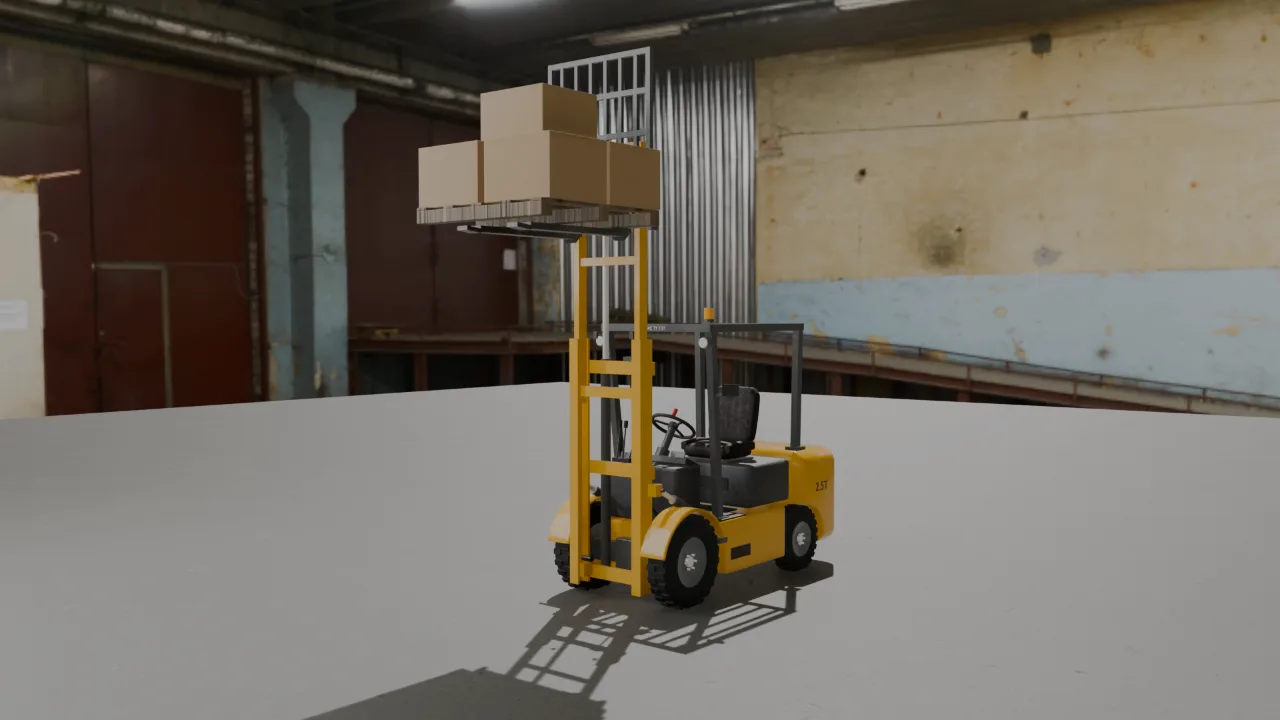
(These capabilities reach Exaro Model as they pass our quality gates; the Exaro Model page lists what's in the product today.)
Your AI, not more credits
Tripo charges credits per generation. Exaro Model runs on the AI you already pay for, such as Claude, Codex or a local model, so iterating on a build doesn't spend from a separate balance.
The bottom line
- Choose Tripo if you want fast generated characters and props with a one-vendor pipeline into your engine.
- Choose Exaro Model if you want models built from real parts and mechanisms, driven by the AI you already use, with clean commercial rights.
Or skip the build entirely: Exaro Assets has finished, rigged props, vehicles and walkable levels, and Exaro Unreal lets your AI put them to work in your project.