Damageable Cars
Three drivable cars that take real damage in Unreal Engine: a sedan, a full-size SUV and a compact crossover whose bodies crush where they are struck, shed panels, crack and burst their glass, and burn under smoke after a hard hit. With the damage and crash-effects runtime as C++ source and a crash yard to wreck them in. For Unreal Engine 5.7 and 5.8.
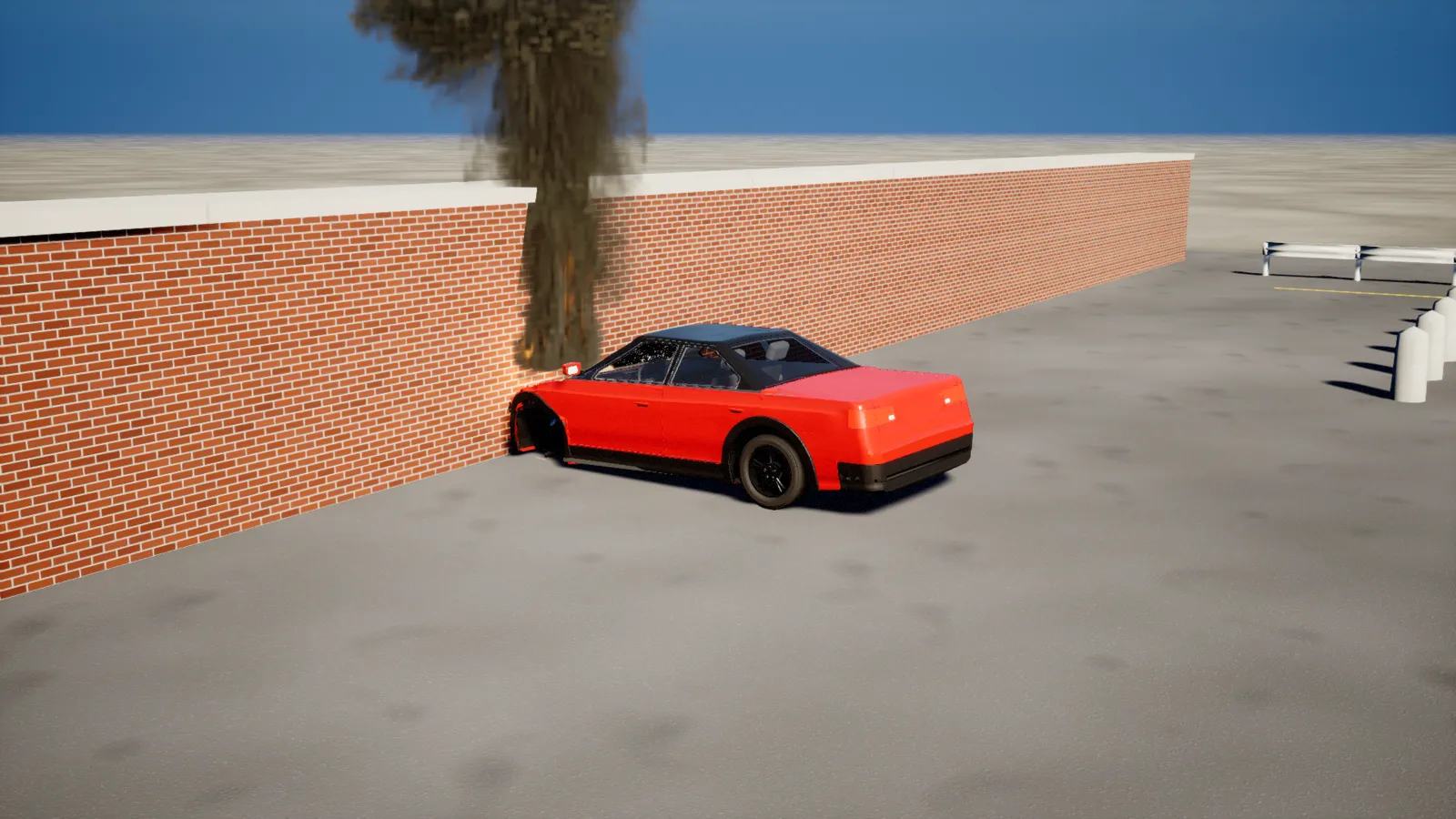
ExaroDamageableCars Content/Maps/L_CrashYard and press Play. Drive with W A S D and aim for the wall. Everything below is detail.1. Install
Damageable Cars is one Unreal code plugin, ExaroDamageableCars, with the C++ source of its two runtime modules (BADamage for the damage, BACrashFx for sparks, fire and smoke) and all of its content inside it: the three car Blueprints, their texture sets, the crash effect and the crash yard level. It needs only plugins that ship with Unreal, Procedural Mesh Component and Niagara, which it turns on for you.
- From Fab: install the plugin to your engine (5.7 or 5.8) from the Epic Games Launcher, then enable it in a project under Edit → Plugins and restart the editor.
- From the Exaro store: one zip holds the
ExaroDamageableCarsplugin and aBinaries for UE 5.xfolder per engine. CopyExaroDamageableCarsinto your project'sPluginsfolder (create it next to your.uprojectfile if it is not there), copy theBinariesfolder for your engine into it, then open the project. Leave the binaries out and Unreal builds the plugin from its source instead, which needs Visual Studio with the Game development with C++ workload. The zip'sINSTALL.txthas the same steps.
The content is under the plugin's mount point, /ExaroDamageableCars: in the Content Browser it appears as ExaroDamageableCars Content once Show Plugin Content is on. Tested on Windows (DirectX 12); the modules are built for Win64.
2. The crash yard
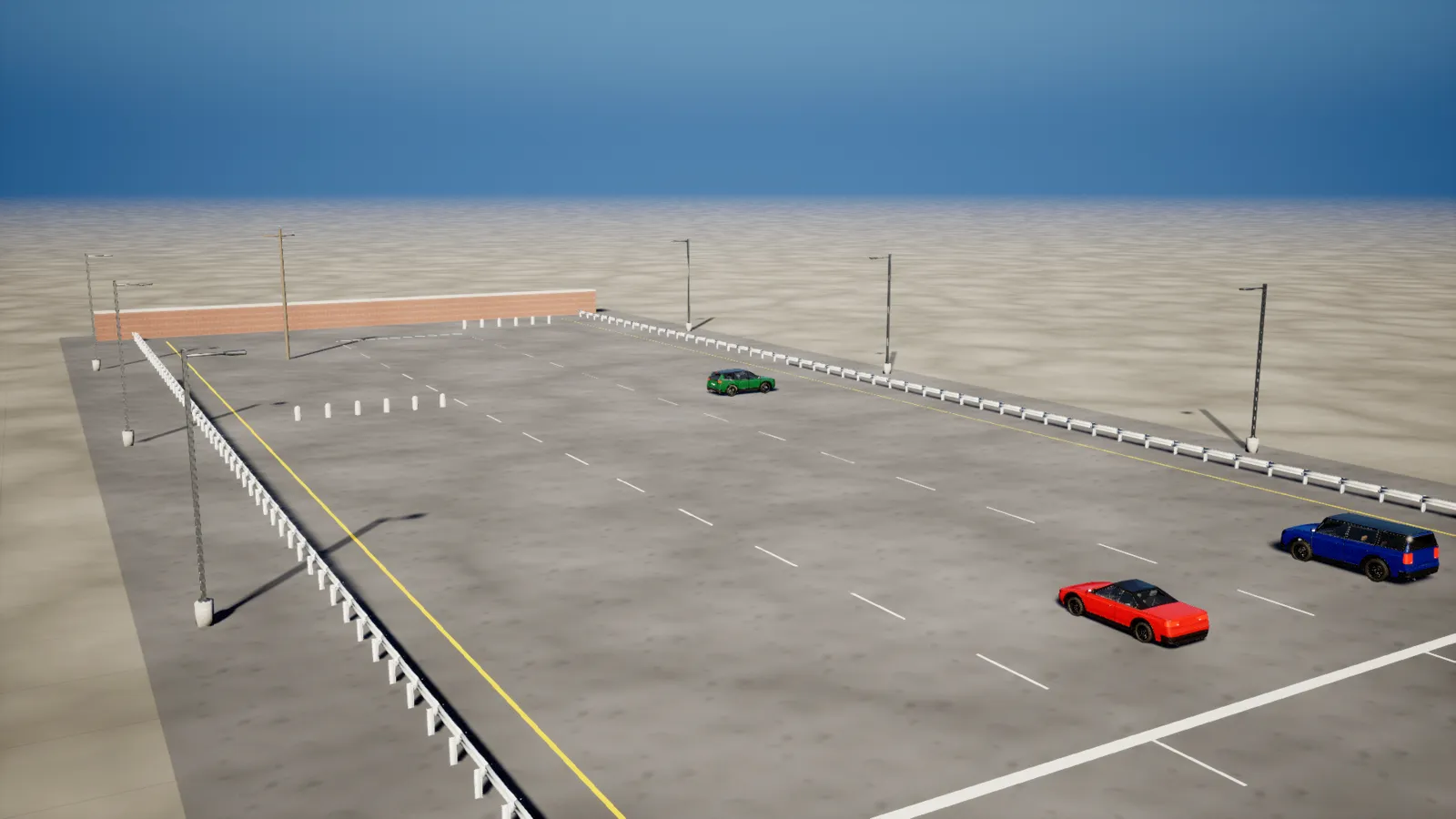
Maps/L_CrashYard is an asphalt yard of three marked lanes ending at a rigid brick wall: a straight run to the wall, a parked crossover to T-bone, and a row of concrete bollards before a utility pole, with guardrails under parking-lot light poles. Press Play and the sedan is yours. Every piece is its own actor, so move anything in the editor and play again.
While driving:
- W and S drive, brake and reverse; A and D steer (the arrow keys work too); Space is the handbrake.
- Tab takes you to the next car; R repairs the car and puts it back on its wheels where it stands; C pulls the camera in or out.
- In the editor, the top left of the screen shows the car, its speed and how far its front has crushed.
3. What the damage does
- The body crushes where it is struck, as deep as the impact's energy drives it: about 20 cm at 25 km/h and about 60 cm at 56 km/h into a rigid barrier, like a crash-tested car, and it stops at the engine block.
- Dents stay where they land and add up hit after hit; paint scrapes to bare steel; the car's collision follows its dents.
- Bonnets, bumpers, doors, mirrors and wheel corners tear off and fall as physics bodies; doors and bonnets can swing open on their hinges first.
- Laminated windscreens crack into a web and stay in place; side and rear glass bursts into pieces.
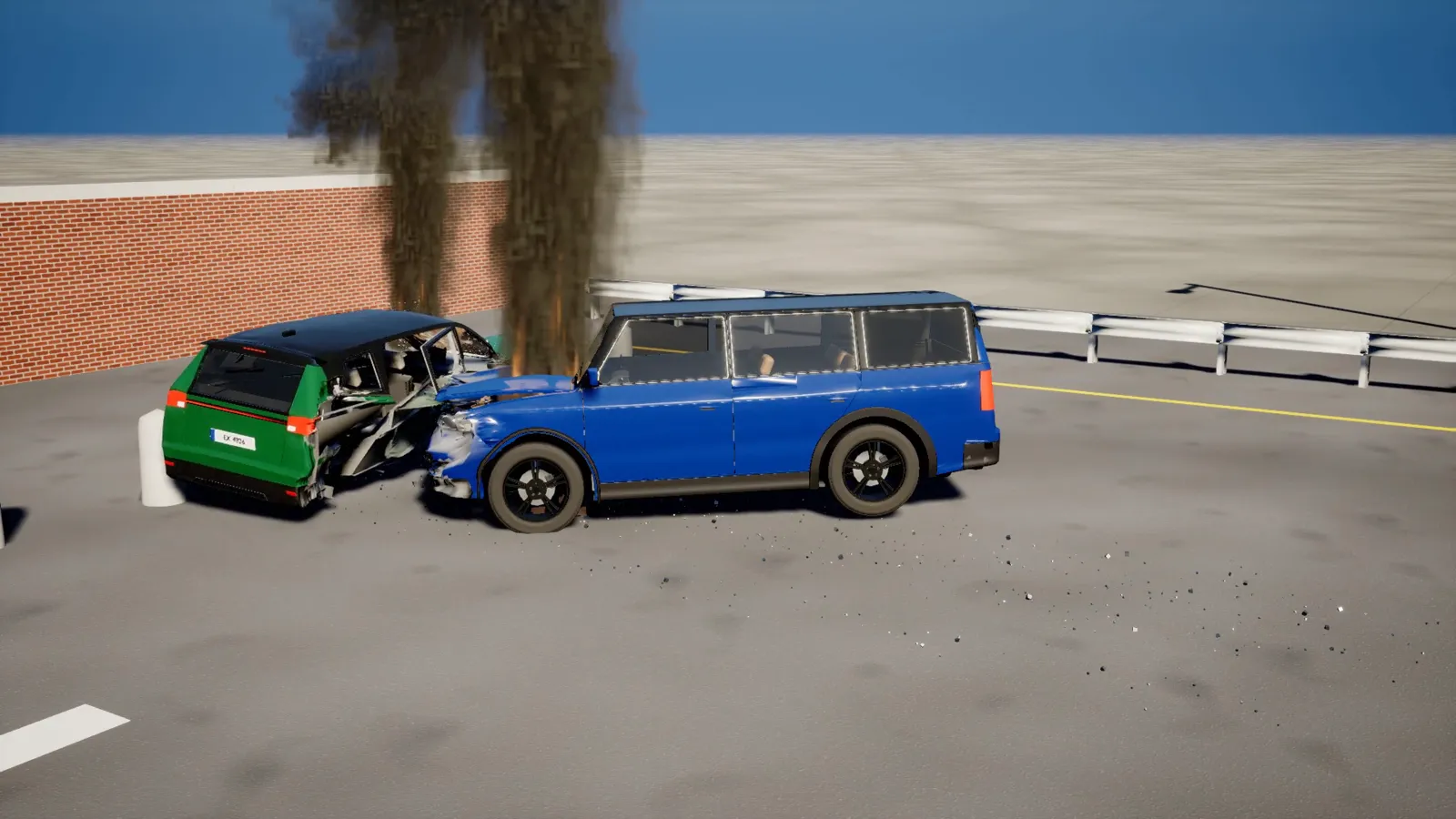
- Car against car, both bodies are damaged by how hard each is hit and where.
4. Put a car in your level
The cars are Blueprints in ExaroDamageableCars Content/Blueprints: BP_Sedan, BP_FullsizeSUV and BP_CompactCrossover. Drag one into your level. To drive it, set its Auto Possess Player to Player 0, or open L_CrashYard to see a level already set up. A car you do not drive is still damageable: park it, or push it with physics.
For sparks, fire and smoke, add one BACrashFx actor to the level (search for Crash Fx in Place Actors) and set its Crash to VFX/NS_Crash. It listens to every damageable car in the level, so there is nothing to wire per car.
Each car's damage profile (which parts are welded, hinged or loose, and how stiff each region is) is a data asset in Data, and its baked texture sets are in Materials/Looks.
5. Tune the damage
Select a car and open the Damage section of its damage component in the Details panel. The ones you will use most:
| Setting | What it does |
|---|---|
| Damage Scale | Multiplies every hit's energy: above 1 for softer, arcade cars; below 1 for tougher ones. |
| Crush Scale | How much the structure gives under broad impacts (a wall, another car's panel, the ground) compared with a poke. |
| Yield J, Side Yield J | The energy a hit must bring before the steel dents at all, along the car and across it. |
| Max Set Cm | The furthest any point of the body can be pushed from where it was made. |
| Head Strike Mps | A frontal hit at least this fast cracks the windscreen (12 m/s, about 43 km/h, by default). |
| Snap Cm | How far a hit must push a part without a hinge, such as a mirror, before it snaps off. |
| Crumple Seconds | How long a dent takes to appear on screen, so a crumple is seen happening. 0 is instant. |
| Shared Hit Share | When two damageable cars meet, the share of the hit this one takes. |
| Hull Slices X, Hull Slices Y | How finely the collision follows the dents. More slices are more exact and cost more when the hull is rebuilt. |
From Blueprint, call Repair to put a car back as built, bind On Impact to react to a hit, and read Crush Cm or Pieces Report for what happened.
6. Fire and smoke
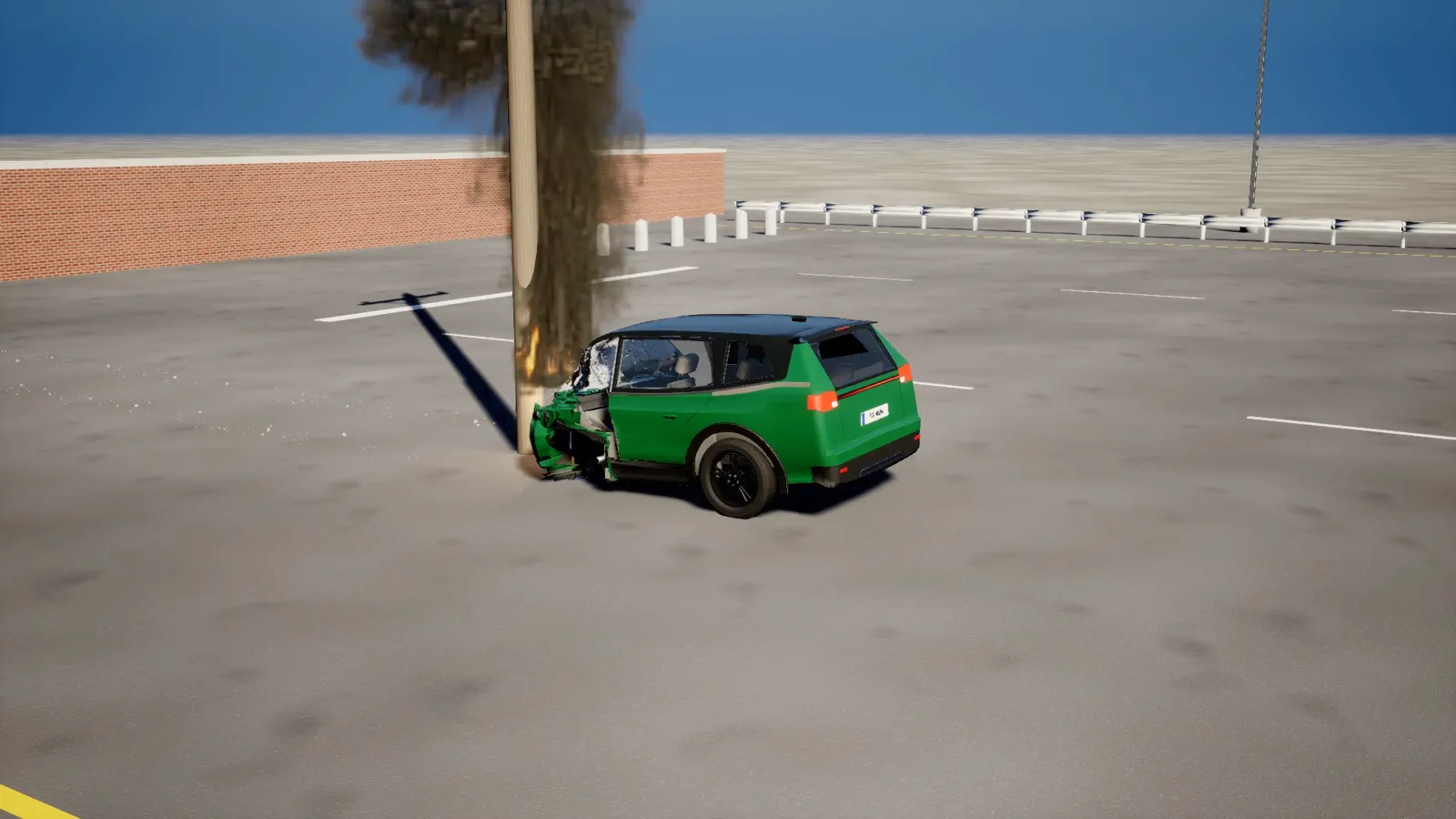
Every hit throws sparks and dust. A hard one bursts a fuel fireball, then the struck engine bay burns under a black smoke column with the fire's own light. One Niagara system, NS_Crash, picks what plays from the impact's energy, so a fender bender throws dust and a 100 km/h wall hit burns. A car still moving fast after the hit catches fire once it slows, so the fire rides its wreck. On the BACrashFx actor:
| Setting | What it does |
|---|---|
| Fuel | Fuel that can spill, 0 to 1 of a full tank. At 0 no crash burns. |
| Wind Mps | The wind: its speed picks a calm or a leaning smoke column. |
| Light Radius Cm, Fire Color, Fire Light Cm | The fire's light: its reach, colour and height above the car. |
| Shot Seconds, Max Shots | How long the dust and sparks of a hit that starts no fire last, and how many play at once. |
| Debris At KJ, Max Debris | The energy from which a hit throws chunks of debris, and how many lie about at once. |
7. Performance
Each car is one deforming mesh with no levels of detail: the sedan has 358,520 triangles, the full-size SUV 211,625 and the crossover 213,363. A dent moves only the vertices it reaches, and the collision is rebuilt from a sample of the body, so the cost of a hit stays flat however many hits came before.